
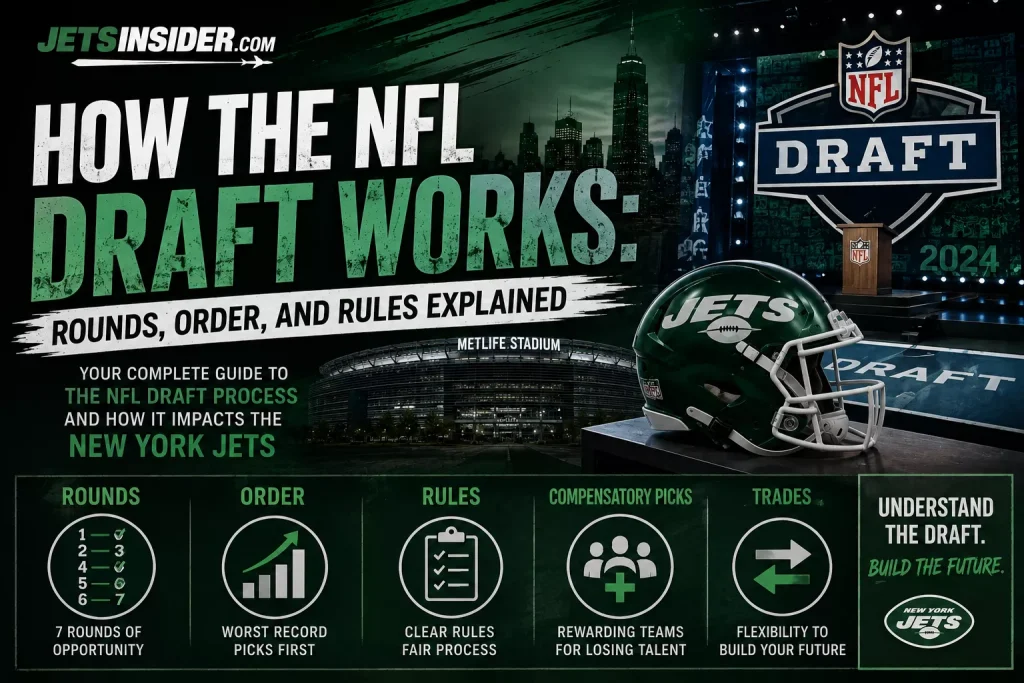
The NFL Draft is the league’s primary talent-acquisition system: a seven-round event, held every April, where all 32 teams take turns selecting eligible college players. This guide explains how the draft works from top to bottom — the rounds, the schedule, who is eligible, and how picks change hands. For the finer points, we link out to companion guides on how draft order is determined and what a compensatory pick is.
The basics: seven rounds over three days
The modern draft runs seven rounds across three days. Round 1 is held Thursday night, Rounds 2–3 on Friday, and Rounds 4–7 on Saturday. With 32 teams plus compensatory selections, roughly 257 players are drafted each year. On the clock, teams get 10 minutes per pick in Round 1, seven minutes in Round 2, five minutes in Rounds 3 through 6, and four minutes in Round 7. If a team doesn’t submit its pick in time, it isn’t skipped — the next team can jump ahead, but the slower team can still turn in its card whenever it’s ready.
Who is eligible
To enter the draft, a player must be at least three years removed from high school graduation and must have used up his college eligibility — or formally declare early as an underclassman. Players who are not selected in any of the seven rounds become undrafted free agents and can sign with any team immediately after the draft ends.
How the draft order is set
In broad terms, teams pick in reverse order of the previous season’s record: the worst non-playoff team selects first and the Super Bowl champion selects last. Playoff teams are slotted behind non-playoff teams, and ties are broken primarily by strength of schedule. Because there are several layers to it, we cover the full process — including tiebreakers and where traded and compensatory picks land — in our dedicated guide on how NFL draft order is determined.
Trades and pick value
Draft picks are assets, and teams trade them constantly — moving up to target a specific player, moving down to collect more selections, or dealing picks for veteran players. Front offices lean on a “draft value chart” that assigns a point value to each slot, which helps both sides gauge whether a trade is roughly fair. A single future first-round pick, for example, is worth far more than a bundle of late-round selections.
Compensatory picks
Beyond the standard 32 selections per round, the league awards extra “compensatory” picks in Rounds 3 through 7 to teams that lost more (or more valuable) qualifying free agents than they signed. These can’t be traded until they’re formally awarded each spring, and they’re a favorite tool of teams that build through the draft. See what a compensatory pick is for the full formula and limits.
What happens after the draft
Once the seventh round ends, teams race to sign undrafted free agents, and drafted rookies enter a slotted contract system with largely predetermined salaries based on where they were picked. From there, the roster-building work shifts to offseason programs, training camp, and the preseason.
Following the Jets’ draft? Our New York Jets Draft Central hub tracks New York’s specific picks, needs, and selections each year. You may also find our guides on how to read an NFL depth chart and the NFL franchise tag useful.
Frequently Asked Questions
How does the NFL Draft work?
The NFL Draft is a seven-round event where all 32 NFL teams select eligible college players. Teams generally pick in reverse order of the previous season’s standings, with draft order adjusted for playoff results, trades, and compensatory picks.
How many rounds are in the NFL Draft?
The NFL Draft consists of seven rounds held over three days. Round 1 takes place on Thursday, Rounds 2 and 3 on Friday, and Rounds 4 through 7 on Saturday.
Who is eligible for the NFL Draft?
Players must be at least three years removed from high school graduation and either have exhausted their college eligibility or officially declare for the draft as an underclassman.
How is the NFL Draft order determined?
The draft order is based primarily on the previous season’s results. Non-playoff teams pick first in reverse order of their records, followed by playoff teams based on how far they advanced.
Can NFL Draft picks be traded?
Yes. Teams regularly trade draft picks to move up or down in the draft or to acquire veteran players. Both current-year and future draft selections may be included in trades.
What are compensatory picks?
Compensatory picks are additional draft selections awarded to teams that lose more qualifying free agents than they sign. These extra picks are added to the end of Rounds 3 through 7.
What happens after the NFL Draft ends?
After the final pick is made, teams immediately begin signing undrafted free agents. Drafted players also sign rookie contracts before participating in offseason workouts, training camp, and the preseason.
Where can I follow the New York Jets’ draft?
JetsInsider’s New York Jets Draft Central provides coverage of the team’s draft picks, roster needs, prospects, and draft analysis throughout the year.
Latest Draft Coverage
Draft news, prospect analysis and pick tracking, newest first.

David Bailey Wins AFC Defensive Player of the Week After a Three-Sack Game
The Jets have spent six weeks looking for something that travels. They may have found it in a rookie edge rusher who has now…
Kenyon Sadiq Wins Pepsi NFL Rookie of the Week After 105-Yard Game
Kenyon Sadiq spent training camp working back from injury. Three games into his NFL career, he has an individual award from the league’s weekly…
Jets 2026 Rookie Minicamp Opens: Bailey, Sadiq, Cooper Sign Deals
The Jets opened 2026 rookie minicamp May 8 with all 8 draft picks signed. David Bailey, Kenyon Sadiq and Omar Cooper Jr lead the…