
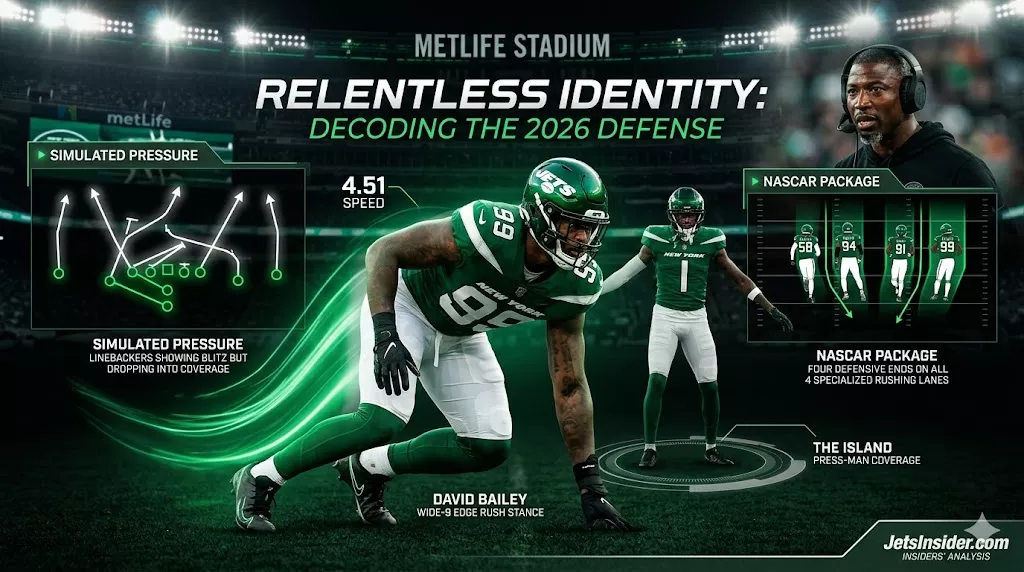
Direct answer: David Bailey, taken No. 2 overall by the New York Jets, immediately reshapes the team’s edge rotation by giving defensive coordinator Aaron Glenn a true three-down rusher opposite Jermaine Johnson. Bailey’s combination of bend, hand usage, and length means the Jets can play him on the strong side in base downs and kick him inside on obvious passing situations. The practical effect: Jermaine Johnson sees fewer double-teams, Will McDonald moves into a designated pass-rush specialist role, and the Jets gain the kind of two-front pressure profile they have not had since the Quinnen Williams-Carl Lawson peak. Expect Bailey to play roughly 70 to 80 percent of defensive snaps as a rookie, with the front-four sub package built around him as soon as training camp.
What happened
The Jets used the No. 2 overall pick on David Bailey, an edge defender who tested as one of the most efficient pass rushers in the class. The selection slots him directly into a starting role and re-orders the Jets’ edge depth chart heading into 2026.
Bailey is the first top-five edge the Jets have drafted in a decade, and he joins a defensive front that already has Quinnen Williams inside and Jermaine Johnson on the opposite edge. The pick fills the team’s largest pre-draft need without forcing a reach.
Why it matters
The Jets’ 2025 pass rush relied heavily on Quinnen Williams generating interior pressure. Edge production was uneven, and Will McDonald — productive in spurts — could not be left on the field every down because of run-defense limitations. Bailey solves that. He is a complete edge who can set the strong-side edge against the run and turn the corner against tackles in pass pro.
Pairing Bailey with Jermaine Johnson also unlocks coordinator Aaron Glenn’s preferred sub-package looks: four-down fronts with Williams kicking outside, Bailey reducing inside, and Johnson coming off the opposite edge. That alignment was rare in 2025 because the Jets lacked the personnel to run it.
What changes next
Snap-count expectations shift across the defensive front. Bailey projects to a 70 to 80 percent snap share. Johnson stays around 75 percent but with cleaner one-on-one looks. McDonald drops to roughly 35 to 45 percent in a pass-rush-only role. The depth chart firms up around a clear top three rather than a committee.
The cap and contract implications follow next year. Williams and Johnson are already on second contracts. Bailey’s rookie deal buys the Jets four years of cost-controlled production at the edge, which gives the front office room to keep Sauce Gardner long-term and address other roster needs.
Projected Jets edge rotation (2026)
| Player | Role | Projected snap share |
|---|---|---|
| David Bailey | Three-down edge / kick inside on passing downs | 70-80% |
| Jermaine Johnson | Strong-side / weak-side edge | ~75% |
| Will McDonald | Designated pass rusher | 35-45% |
| Micheal Clemons | Rotational run-down edge | 20-30% |
In Brief
The 2026 New York Jets defensive system, led by head coach Aaron Glenn, has evolved into a “multiple” hybrid front that primarily operates out of a 4-3 base. The philosophy relies on a relentless four-man rush to protect a secondary that plays aggressive, press-man coverage. With the addition of No. 2 overall pick David Bailey, the unit now utilizes “simulated pressures” and “NASCAR” speed packages to disrupt modern passing games without sacrificing deep-field integrity.
- David Bailey is the No. 2 overall pick and an immediate starter for the New York Jets.
- He gives Aaron Glenn a three-down edge opposite Jermaine Johnson — something the Jets lacked in 2025.
- Will McDonald slides into a pass-rush specialist role, reducing his snap count but improving efficiency.
- Quinnen Williams gains more one-on-one looks inside as offenses account for Bailey on the edge.
- Bailey’s rookie deal protects future cap flexibility around Sauce Gardner and Garrett Wilson.
Key takeaways
- Bailey reshapes the edge depth chart from a committee into a clear top-three rotation.
- The Jets gain a complete edge who can hold against the run, not just rush the passer.
- Snap-count math now favors fewer rotation packages and more base-personnel pressure.
Related coverage on the Jets
For more roster and scheme context, see the Jets analysis hub, the Jets defense breakdown, and what it means for the Jets. Player-page: Jermaine Johnson.
Frequently asked questions
Who is David Bailey on the New York Jets?
David Bailey is an edge defender selected by the New York Jets with the No. 2 overall pick. He projects as an immediate starter and three-down player.
How many snaps will David Bailey play as a rookie?
Bailey is expected to play 70 to 80 percent of defensive snaps, including base and sub packages, opposite Jermaine Johnson.
Does the David Bailey pick affect Will McDonald?
Yes. McDonald shifts into a designated pass-rush role with a lower snap count but higher per-snap efficiency.
Why was David Bailey worth the No. 2 pick for the Jets?
Bailey is a complete edge who can defend the run and rush the passer, filling the Jets’ biggest pre-draft need without reaching at the position.
How does David Bailey change the Jets pass rush?
Bailey gives Aaron Glenn a four-man rush that can win without blitzing, freeing Quinnen Williams for one-on-one matchups inside.