
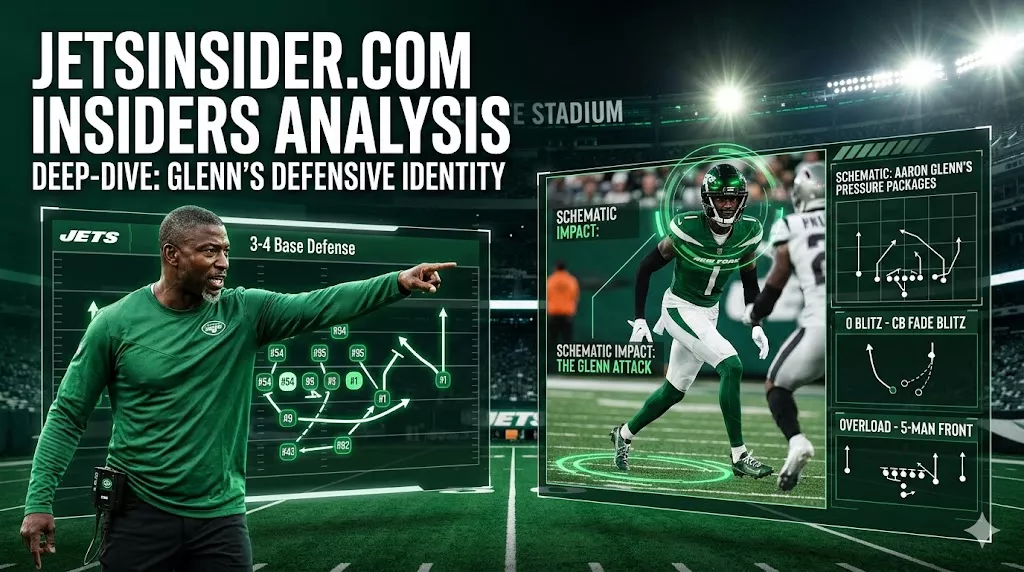
The 2026 New York Jets defensive system, led by head coach Aaron Glenn, is defined by an aggressive, front-four-led philosophy designed to dictate the tempo of the game. Operating primarily out of a base 4-3 alignment, the unit focuses on winning the line of scrimmage with a relentless pass rush while utilizing elite man-to-man coverage in the secondary. That identity did not translate in 2025: the Jets went 3-14 and became the first team in NFL history to finish a season without a single interception. The 2026 system is a rebuild of the same philosophy with different personnel and a different play-caller.
What’s Happening
Aaron Glenn fired defensive coordinator Steve Wilks in December 2025 and has taken defensive play-calling back himself for 2026, with no coordinator named above him. Glenn built one of the league’s better defenses as the Lions’ coordinator before taking the Jets job, and he has been explicit that this is the part of the operation he trusts himself with. The strategic focus includes more “simulated pressures”—looks that appear to be blitzes but result in a standard four-man rush—intended to confuse opposing quarterbacks. No. 2 overall pick David Bailey is the blue-chip addition to an edge rotation that has to replace departed production.
Why It Matters
This system matters because it is a bet the Jets have to win. A four-man rush that generates pressure lets the defense keep seven in coverage and play the press man Glenn prefers. A four-man rush that does not leaves the secondary on islands with no help — which is roughly the story of 2025. Following the offseason trades of Quinnen Williams, Sauce Gardner and Jermaine Johnson, the pressure has to come from a younger and considerably cheaper front, and whether it does is the defining question of the season.
What Changes Next
As rookie David Bailey acclimates to the professional speed, expect Aaron Glenn to unleash more creative “NASCAR” packages on third downs, featuring four defensive ends on the field simultaneously. The more urgent priority is takeaways. A defense coming off a zero-interception season does not fix that with effort; it fixes it with pressure that forces early throws, and with coverage discipline that puts defenders in position to catch the ones that come.
In Brief
- The Jets operate an aggressive 4-3 defensive system that prioritizes a four-man pass rush.
- Glenn took back defensive play-calling for 2026 after firing coordinator Steve Wilks in December 2025.
- The 2025 unit finished without an interception, an NFL first — generating takeaways is the stated priority.
- Quinnen Williams, Sauce Gardner and Jermaine Johnson were all traded in the roster teardown.
- 2026 top pick David Bailey adds elite speed to the edge rotation for immediate tactical impact.
To see how these defensive schemes impact the depth chart, check our Roster Strategy. For real-time updates, visit our Latest News and Insiders’ Analysis. Our scouting reports indicate that David Bailey is already mastering the Glenn system.
Correction, August 24, 2026: An earlier version of this article described the 2025 defense as a top-ranked unit and named Quinnen Williams and Sauce Gardner as current Jets. Both were traded in the 2025-26 roster teardown, and the 2025 defense finished without an interception. The article has been updated.
Frequently Asked Questions
What is the difference between the 4-3 and 3-4 defense?
A 4-3 uses four down linemen and three linebackers, focusing on defensive line penetration rather than linebacker blitzing.
What is the ‘NASCAR’ package in the Jets’ defense?
It is a sub-package that puts four elite edge rushers on the field at once to maximize speed and pressure on obvious passing downs.
How does ‘simulated pressure’ work?
The Jets show a blitz look before the snap but drop defenders into coverage, rushing only four to confuse the quarterback’s read.
What is David Bailey’s defensive role?
As the No. 2 overall pick, Bailey is the designated rotational pass-rush specialist, expected to feature heavily in the NASCAR package.
What is the weakness of a man-to-man heavy scheme?
The man-heavy scheme can be susceptible to pick routes and quick-release passing games that target linebacker mismatches.