
New York Jets Super Bowl history
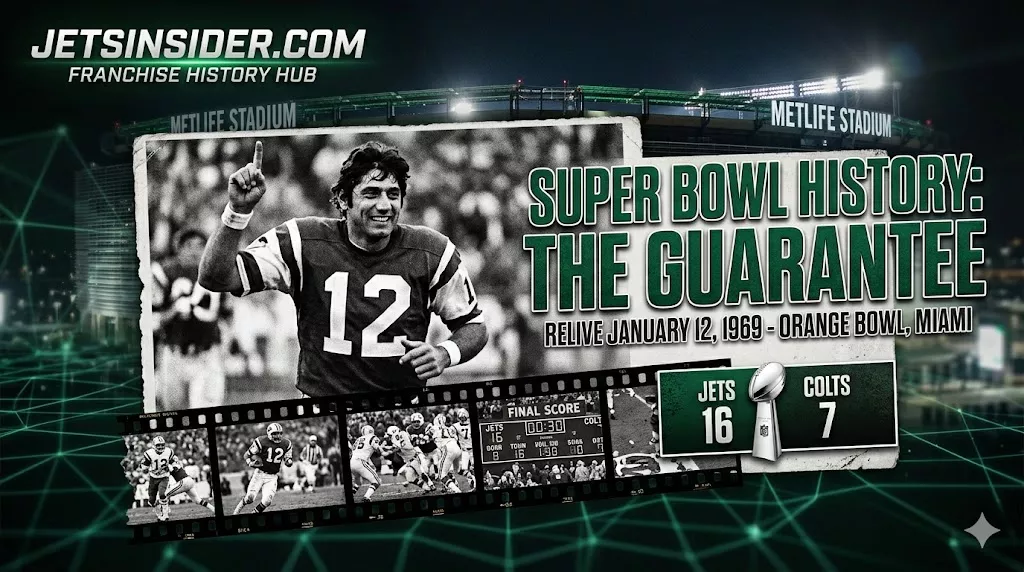
While the New York Jets Super Bowl history features just a single appearance, it stands as arguably the most influential game ever played in professional sports. Entering January 12, 1969, as massive 18-point underdogs to the powerhouse Baltimore Colts, the American Football League (AFL) champion Jets did more than just secure a world championship—they forced the sports world to respect an entire league. Backed by quarterback Joe Namath’s audacious, immortalized game-week “guarantee,” a suffocating defensive game plan, and Matt Snell’s relentless ground attack, Gang Green’s 16-7 victory codified the legitimacy of the AFL-NFL merger and permanently altered the trajectory of modern football history.
| Category | Game Details & Historical Data |
|---|---|
| The Matchup | New York Jets (AFL) vs. Baltimore Colts (NFL) |
| Date & Venue | January 12, 1969 | Orange Bowl (Miami, FL) |
| The Betting Line | Colts -18 (One of the largest point spreads in Super Bowl history) |
| Final Score | New York Jets 16, Baltimore Colts 7 |
| Game MVP | Joe Namath (17/28 passing, 206 yards) |
| Key Performer | Matt Snell (30 carries, 121 rushing yards, 1 TD; 4 receptions, 40 yards) |
| Defensive Impact | 4 Total Takeovers (3 Interceptions off Earl Morrall, 1 off Johnny Unitas) |
The Weather Factor: Wind, Humidity, and the Orange Bowl Surface
The Environmental Replay
Kickoff at the Orange Bowl saw a temperature of 73°F with a heavy 76% humidity blanket settling over the stadium. However, the true environmental X-factor was a sustained, swirling 12 mph wind gusting out of the northeast, slicing across the open-ended stadium bowl.
While the mild Florida winter temperature seemed ideal on paper, the thick, natural grass surface of the Orange Bowl was heavily chewed up from a grueling week of practice and pre-game festivities. The damp, humid air quickly turned the grass greasy and slick, creating treacherous footing for both teams’ high-speed edge rushers and wide receivers.
The Tactical Impact
- Neutralizing the Colts’ Deep Game: The swirling northeast winds heavily disrupted high, lofted passes. Knowing this, the Jets’ secondary intentionally played a “flat-top” coverage scheme, allowing short underneath routes but daring Earl Morrall to test the unpredictable crosswinds along the sidelines. It backfired on Baltimore completely; Morrall’s deep throws consistently drifted, assisting in two of the Jets’ four interceptions.
- The Winston Hill Advantage: The slick, greasy grass surface severely punished edge defenders who relied on hard, sudden lateral cuts. Jets offensive tackle Winston Hill adjusted brilliantly by switching to longer cleats before kickoff. This allowed him to establish a rock-solid anchor in the turf, whereas Colts pass-rusher Ordell Braase repeatedly lost his footing and slipped when attempting to execute his signature speed-bend around the edge.
- The Tactical Shift to the Ground: Recognizing that the high humidity and slippery turf would cause skill players to fatigue rapidly in the second half, coach Weeb Ewbank leaned aggressively into the ground attack early on. By running Matt Snell 30 grueling times directly into the humid afternoon air, the Jets intentionally wore down a heavily breathing, exhausted Colts defensive line by the mid-third quarter.
First Quarter: Setting the Physical Tone
The Replay
The game opened with a palpable tension. The Colts immediately tried to establish dominance, driving deep into New York territory after a couple of uncharacteristic Jets miscues. Baltimore quarterback Earl Morrall began picking at the edges of the Jets’ secondary.
However, the momentum permanently shifted on a single physical sequence. Colts tight end John Mackey—the most terrifying physical weapon in football at the time—caught a pass over the middle. Jets safety Johnny Sample met him instantly with a bone-jarring tackle, forcing a fumble that New York recovered.
When Joe Namath took the field for his first sequence, he didn’t attack downfield. Instead, he immediately went to work executing Ewbank’s blueprint: handing the ball to fullback Matt Snell on heavy, repetitive left-tackle runs behind tackle Winston Hill, mixed with lightning-quick look-in passes to tight end Pete Lammons.
The Tactical Analysis
- Winston Hill vs. Ordell Braase: The game was won in this specific matchup. Hill completely neutralized Braase, the Colts’ premier edge rusher, with an aggressive pass-blocking set that prevented him from using his signature speed rush.
- Disrupting the Zone: Namath’s quick-release slides completely bypassed Baltimore’s linebackers. By getting the ball out in under two seconds, “Broadway Joe” rendered the Colts’ aggressive blitz packages entirely useless.
Second Quarter: The March and The Breakthrough
The Replay
The second quarter featured the defining drive of the game—a masterpiece of situational football. Starting from their own 20-yard line, Namath orchestrated a grueling, 12-play, 80-yard drive that chewed clock and completely exhausted the Colts’ defensive front.
Snell was an absolute workhorse, carrying the ball on consecutive plays to punish the Baltimore midsection. On a crucial 3rd-and-4, Namath fired a laser to Al Denson to keep the chains moving. The drive culminated in a grueling, 4-yard off-tackle blast by Matt Snell, who lowered his shoulder and bulldozed through two Colts defenders into the left corner of the end zone.
Jets 7 – Colts 0
The Colts tried to respond immediately. Morrall drove Baltimore down to the Jets’ 6-yard line. On a crucial third down, Morrall attempted to force a pass into tight coverage, but Jets cornerback Randy Beverly tracked the ball flawlessly, snaring a spectacular interception in the end zone to kill the threat.
The Tactical Analysis
- The Power G-Lead: The Jets found massive success using a “G-Lead” blocking scheme, pulling guard Randy Rasmussen to pave a massive path for Snell. This scheme manipulated the Colts’ lateral pursuit angles perfectly.
- Secondary Bracket Coverage: Defensive coordinator Walt Michaels adjusted his coverages dynamically, keeping safety help bracketed over the top of Colts star receiver Jimmy Orr, forcing Morrall to make tightly contested throws into the teeth of the defense.
Third Quarter: Suffocation and Frustration
The Replay
The second half began with the Colts completely out of sync. Frustrated by New York’s defensive front, Baltimore began abandoning their established running game.
Namath remained coolly efficient. Realizing the Colts were starting to over-commit to stopping Snell up the middle, Namath began utilizing play-action. He connected with wide receiver George Sauer on two massive sideline routes, setting up Jim Turner for a 32-yard field goal to extend the lead.
Jets 10 – Colts 0
On the ensuing Baltimore drive, the Jets’ pass rush hit home. Defensive end Verlon Biggs collapsed the pocket, forcing a hurried throw from Morrall that landed directly into the arms of safety Johnny Sample. The veteran cornerback, who had been trading trash-talk with the Colts’ sideline all afternoon, gleefully slammed the ball onto the turf. Namath capitalized on the turnover, driving the offense within range for another Jim Turner field goal.
Jets 13 – Colts 0
The Tactical Analysis
- George Sauer’s Route Tree: With the Colts trying to cheat their safeties into the box to stop Matt Snell, George Sauer exposed cornerback Bobby Boyd on hard-breaking comeback routes. Sauer finished the day with 8 receptions for 133 yards, consistently serving as Namath’s safety valve.
- Front-Four Discipline: The Jets’ defensive line—Verlon Biggs, Gerry Philbin, John Elliott, and Paul Rochester—rarely over-pursued. They played a disciplined “contain-first” style that took away Morrall’s lanes to step up in the pocket.
Fourth Quarter: Sealing the Absolute Upset
The Replay
As the final quarter opened, Don Shula made a desperate move, benching the NFL MVP Earl Morrall and inserting the legendary, yet heavily ailing, Johnny Unitas at quarterback.
Before Unitas could find a rhythm, Namath engineered another methodical drive, leaning heavily on the ground game to bleed the clock. Jim Turner capped it off with his third field goal of the day from 9 yards out, putting the game seemingly out of reach.
Jets 16 Colts 0
Unitas showed flashes of his Hall of Fame brilliance, engineering a late, desperate drive that resulted in a 1-yard touchdown run by Jerry Hill with just over three minutes left on the clock.
Jets 16 Colts 7
But it was too little, too late. The Colts attempted an onside kick, which was cleanly recovered by the Jets. On the final possession, Namath didn’t throw a single pass. He repeatedly handed off to Snell, letting the offensive line dictate the final seconds of the game.
As the clock struck zero, Namath famously ran off the field of the Orange Bowl, raised his index finger to confirm the “#1” status he had promised all week, and vanished into the tunnel as a world champion.
The Tactical Analysis
- Clock Management: Ewbank’s fourth-quarter play-calling was a masterclass in game theory. By utilizing the full 30-second play clock on every single down, the Jets completely eliminated any opportunity for a Unitas-led miracle comeback.
- The Final Int: Randy Beverly’s second interception of the day earlier in the fourth quarter highlighted New York’s schematic superiority. The Jets dropped into a deep Cover 3 look, baiting Unitas into throwing deep down the seam where Beverly was waiting over the top.
The Film Room Verdict
Super Bowl III was not a fluke or a collection of lucky breaks; it was a comprehensive schematic dismantling. The Jets out-gained the Colts 337 to 260, controlled the time of possession for over 36 minutes, and fundamentally forced the NFL to rewrite how it evaluated AFL talent. Joe Namath’s arm talent and legendary confidence laid the foundation, but Weeb Ewbank’s brilliant situational game plan and an offensive line that played a flawless game are what truly delivered the Lombardi Trophy to New York.{ “page_metadata”: { “primary_keyword”: “New York Jets Super Bowl history”, “secondary_keywords”: [ “Jets Super Bowl III win”, “Joe Namath guarantee 1969”, “Jets vs Colts Super Bowl stats”, “AFL champion New York Jets” ], “seo_title”: “New York Jets Super Bowl History: The Legendary Super Bowl III Triumph”, “meta_description”: “The definitive history of the New York Jets in the Super Bowl. Relive Joe Namath’s iconic guarantee and the historic Super Bowl III upset.”, “url_slug”: “/franchise-history/super-bowl-history/” }, “header_image”: { “file_name”: “new-york-jets-super-bowl-iii-history-namath.png”, “image_title”: “New York Jets Super Bowl III Champions Archive | JetsInsider.com”, “alt_text”: “Vintage-inspired high-contrast historical header for JetsInsider.com celebrating Super Bowl III. Features a stylized retro layout of Joe Namath jogging off the Orange Bowl field wagging his index finger, alongside old-school film reel graphics, the final score ‘JETS 16 – COLTS 7’, and bold text reading ‘SUPER BOWL HISTORY: THE GUARANTEE’.” }, “content_sections”: { “in_brief”: “While the New York Jets Super Bowl history features just a single appearance, it stands as arguably the most influential game ever played in professional sports. Entering January 12, 1969, as massive 18-point underdogs to the powerhouse Baltimore Colts, the American Football League (AFL) champion Jets did more than just secure a world championship—they forced the sports world to respect an entire league. Backed by quarterback Joe Namath’s audacious, immortalized game-week ‘guarantee,’ a suffocating defensive game plan, and Matt Snell’s relentless ground attack, Gang Green’s 16-7 victory codified the legitimacy of the AFL-NFL merger and permanently altered the trajectory of modern football history.”, “strategic_backdrop”: { “title”: “The Strategic Backdrop: Changing the Tape”, “body”: “Heading into the Orange Bowl, NFL pundits dismissed the AFL Champion Jets because of a perceived gap in defensive physicality. Baltimore Colts head coach Don Shula ran an efficient, high-volume blitzing machine under defensive coordinator Phil Bengtson. However, Jets head coach Weeb Ewbank and offensive coordinator Clive Rush recognized a fatal flaw on the Colts’ film: Baltimore relied heavily on a fixed, predictable zone rotation. Instead of trying to out-muscle the Colts, Ewbank designed a game plan built entirely on maximum protection, short horizontal passing lanes, and a relentless, off-tackle running game to wear down Baltimore’s front four.” }, “weather_impact”: { “title”: “The Weather Factor: Wind, Humidity, and the Orange Bowl Surface”, “environmental_replay”: “Kickoff at the Orange Bowl saw a temperature of 73°F with a heavy 76% humidity blanket settling over the stadium. However, the true environmental X-factor was a sustained, swirling 12 mph wind gusting out of the northeast, slicing across the open-ended stadium bowl. While the mild Florida winter temperature seemed ideal on paper, the thick, natural grass surface of the Orange Bowl was heavily chewed up from a grueling week of practice and pre-game festivities. The damp, humid air quickly turned the grass greasy and slick, presenting a treacherous footing situation for both teams’ high-speed edge rushers and wide receivers.”, “tactical_impact_points”: [ “Neutralizing the Colts’ Deep Game: The swirling northeast winds heavily disrupted high, lofted passes. Knowing this, the Jets’ secondary played a flat-top coverage scheme, allowing short underneath routes but daring Earl Morrall to test the unpredictable crosswinds down the boundaries. It backfired on Baltimore completely; Morrall’s deep throws drifted, assisting in two of the Jets’ four interceptions.”, “The Winston Hill Advantage: The slick, greasy grass surface severely punished edge defenders who relied on hard, sudden lateral cuts. Jets offensive tackle Winston Hill adjusted brilliantly by switching to longer cleats before kickoff. This allowed him to establish a rock-solid anchor in the turf, whereas Colts pass-rusher Ordell Braase repeatedly lost his footing when attempting to execute his speed-bend.”, “The Tactical Shift to the Ground: Recognizing that the heavy humidity and slippery turf would cause skill players to fatigue rapidly in the second half, coach Weeb Ewbank leaned aggressively into the ground attack early. By running Matt Snell 30 grueling times directly into the humid afternoon air, the Jets intentionally wore down a heavily breathing, exhausted Colts defensive line by the mid-third quarter.”