
New York Jets franchise history
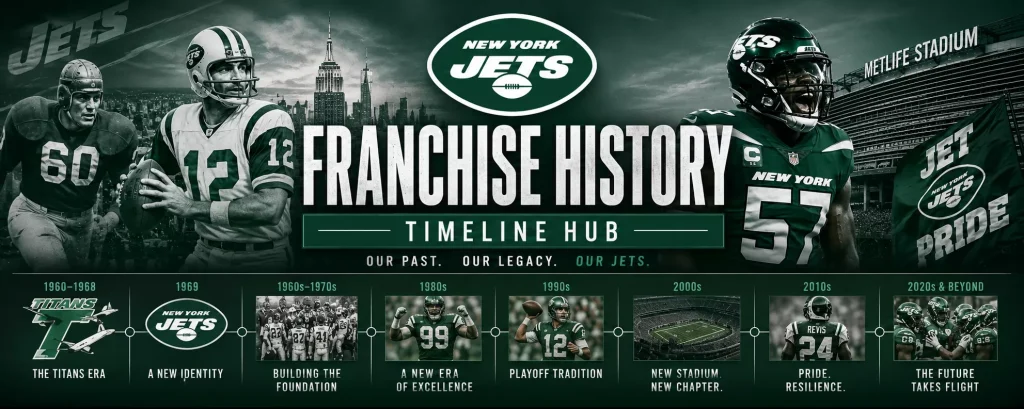
The New York Jets ‘History is one of the most resilient and culturally significant sagas in professional sports. From its rocky birth in the American Football League as a cash-strapped startup at the Polo Grounds to one of the biggest upset victories in American sports, the New York Jets have always brought drama. Founded in 1960 as the Titans of New York before rebranding in 1963, the franchise forever altered the landscape of pro football by validating the American Football League (AFL) via a historic upset in Super Bowl III. From the gritty Polo Grounds origins and the high-flying Shea Stadium eras to the modern battlegrounds of MetLife Stadium, this master archive serves as your definitive portal into the timelines, legendary figures, and structural evolutions that define the identity of Gang Green.
The Chronological Franchise Timeline
1960–1962: The Titans of New York & Polo Grounds Roots
| Era Metric | Historical Data |
| Best Season | 1960 & 1961 (7-7 Records) |
| Defining Coach | Sammy Baugh |
| Standout Players | WR Don Maynard, QB Al Dorow, OT Winston Hill, LB Larry Grantham |
Era Summary
The franchise began play in 1960 as a charter member of the upstart American Football League (AFL), operating under the moniker The Titans of New York. Orchestrated by original owner Harry Wismer, the team utilized the antiquated Polo Grounds in Manhattan as its home turf. Though reasonably competitive on the gridiron under head coach Sammy Baugh, the Titans were a severe financial and box-office disaster. Fraught with organizational instability and teetering on the brink of bankruptcy, the franchise required a comprehensive structural rescue to survive beyond the league’s infancy.
The Era-Defining Game: November 24, 1960 — The Polo Grounds Thanksgiving Shootout
- The Matchup: Titans of New York 41, Dallas Texans 35
- The Drama: In front of a sparse, chilly Thanksgiving Day crowd at the Polo Grounds, the Titans put on a display of the wild, unhinged passing offense that defined early AFL football. Facing Hank Stram’s Dallas Texans, the Titans fell behind 14-0 early. What followed was a furious, track-meet comeback led by quarterback Al Dorow, who threw for 297 yards and three touchdowns. The game featured wildly swinging momentum, five lead changes, and a chaotic fourth quarter where the teams traded blows like heavyweights. This shootout proved to local New York media that while the Titans lacked NFL prestige, their product was exponentially more explosive and entertaining.
1963–1976: The Space Age, Sonny Werblin, and “Broadway Joe”
| Era Metric | Historical Data |
| Best Season | 1968 (11-3 Regular Season | Super Bowl III Champions) |
| Defining Coach | Weeb Ewbank |
| Standout Players | QB Joe Namath, WR Don Maynard, WR George Sauer, RB Matt Snell, OT Winston Hill |
Era Summary
In February 1963, a five-man syndicate led by legendary entertainment executive David “Sonny” Werblin purchased the bankrupt club for $1,000,000. Werblin immediately re-engineered the team’s identity: rebranding them as the New York Jets to align with the modern space-age era and moving them to newly constructed Shea Stadium in Queens by 1964. The franchise trajectory permanently shifted on January 2, 1965, when Werblin signed Alabama quarterback Joe Namath to an unprecedented, record-shattering $400,000 contract. Following Namath’s departure in 1976, the team entered a prolonged structural rebuild.
The Era-Defining Game: December 29, 1968 — The AFL Championship Track Meet
- The Matchup: New York Jets 27, Oakland Raiders 23
- The Drama: While Super Bowl III is the most famous game of this era, the AFL Championship Game against the hated Oakland Raiders at Shea Stadium was a far more dramatic, pulse-pounding contest. Just weeks after the infamous “Heidi Game,” the Jets welcomed Oakland to a freezing, wind-swept Queens. Trailing 23-20 in the fourth quarter, Joe Namath defied the brutal crosswinds, uncorking a magnificent, game-winning 6-yard touchdown laser to Don Maynard into the back of the end zone. The stadium shook so violently from fan celebration that the structural columns of Shea Stadium visibly vibrated. It was the gritty, emotional victory that launched them into immortality.
- Deep-Dive Resource: Explore the complete, tactical, quarter-by-quarter breakdown of the ensuing championship game on our dedicated New York Jets Super Bowl History..
1977–1989: The Shea Farewell & The Move to the Meadowlands
| Era Metric | Historical Data |
| Best Season | 1982 (6-3 Strike Season, reached AFC Championship) | 1985 (11-5 Record) |
| Defining Coach | Walt Michaels & Joe Walton |
| Standout Players | DE Mark Gastineau, DT Joe Klecko, WR Wesley Walker, QB Ken O’Brien, TE Mickey Shuler |
Era Summary
The late 1970s and 1980s were defined by a fierce defensive identity and major stadium geography. Spearheaded by the ferocious defensive line known as the “New York Sack Exchange”—anchored by Mark Gastineau and Joe Klecko—the Jets recaptured intense regional relevance. Structurally, the biggest shift occurred after the 1983 season, when the organization officially left Shea Stadium and relocated to the Meadowlands Sports Complex in New Jersey for the 1984 campaign.
The Era-Defining Game: September 21, 1986 — The Overtime Masterpiece
- The Matchup: New York Jets 51, Miami Dolphins 45 (OT)
- The Drama: Widely regarded as one of the greatest games ever played in NFL history, this AFC East showdown at the Meadowlands was an offensive explosion of volcanic proportions. Jets quarterback Ken O’Brien went toe-to-toe with Dan Marino, trading haymakers in a game that accumulated 1,020 total yards of offense. Trailing by 14 points in the fourth quarter, O’Brien engineered a stunning comeback, capping it off with a miraculous, last-second 21-yard touchdown pass to Wesley Walker to force overtime. In the extra period, O’Brien found Walker yet again for a walk-off 43-yard bomb, sealing Walker’s fourth touchdown of the day and sending the stadium into utter bedlam.
1990–2014: Corporate Rebounds & The Modern Postseason Runs
| Era Metric | Historical Data |
| Best Season | 1998 (12-4 Regular Season | AFC Championship Appearance) |
| Defining Coach | Bill Parcells & Rex Ryan |
| Standout Players | RB Curtis Martin, CB Darrelle Revis, WR Wayne Chrebet, C Nick Mangold, LB Mo Lewis |
Era Summary
This multi-decade block brought heavy structural investments and elite coaching architectures to the franchise. Legendary coach Bill Parcells took full control of football operations in 1997, immediately engineering a spectacular turnaround that resulted in an elite 12-4 campaign in 1998. Following the acquisition of the team by Woody Johnson in 2000, the franchise enjoyed highly consistent competitive windows, highlighted by the raucous, back-to-back AFC Championship appearances in 2009 and 2010 under head coach Rex Ryan.
The Era-Defining Game: January 16, 2011 — The Silencing of Gillette Stadium
- The Matchup: New York Jets 28, New England Patriots 21 (AFC Divisional Round)
- The Drama: Fueled by a week of intense trash-talk, vitriol, and bad blood, Rex Ryan took his underdog Jets into Foxborough to face a Tom Brady-led Patriots squad that had embarrassed them 45-3 just weeks prior. What followed was a tactical masterclass. The Jets’ defense relentlessly harassed Brady, breaking his streak of 340 passes without an interception. Leading late, Mark Sanchez delivered an absolute dime to Santonio Holmes in the corner of the end zone, followed by a bruising, game-sealing touchdown burst by Shonn Greene. Rex Ryan running down the sideline in pure, unadulterated ecstasy remains the defining image of modern Gang Green football.
- Deep-Dive Resource: To see where this iconic squad ranks among the absolute greatest single-year rosters ever assembled, read our comprehensive analytical feature on the Best Seasons in Franchise History.
2015–Present: The MetLife Era & Ongoing Search for Stability
| Era Metric | Historical Data |
| Best Season | 2015 (10-6 Regular Season Record) |
| Defining Coach | Todd Bowles | Aaron Glenn |
| Standout Players | WR Brandon Marshall, DT Quinnen Williams, CB Sauce Gardner, WR Garrett Wilson |
Era Summary
Since moving its training footprint to a state-of-the-art facility in Florham Park, New Jersey, the modern-era Jets have faced a grueling battle to sustain elite consistency. Passing through various regime changes—including a Todd Bowles 10-6 campaign that fell agonizingly short of the postseason and an eventual cultural rebuild under new head coach Aaron Glenn—the front office has consistently focused on building through premier young draft capital to re-establish a stable championship foundation.
The Era-Defining Game: September 11, 2023 — The Ultimate Emotional Rollercoaster
- The Matchup: New York Jets 22, Buffalo Bills 16 (OT)
- The Drama: No game in modern sports history matches the localized, agonizing heartbreak and subsequent exhilarating shock of this Monday Night Football opener. The entire offseason of hype evaporated just four snaps into the game when superstar quarterback Aaron Rodgers suffered a season-ending torn Achilles. The stadium fell into a stunned, funereal silence. Yet, the Jets’ defense refused to fold, forcing four turnovers off Josh Allen. In overtime, rookie returner Xavier Gipson fielded a punt and sliced through the Buffalo coverage unit for a walk-off, 65-yard touchdown return, sparking an explosion of pure catharsis from a fanbase that had been emotionally tested just hours prior.
Also, view the best season and the Rivalries through the years.
Latest From the Archives
History and retrospective pieces, newest first.
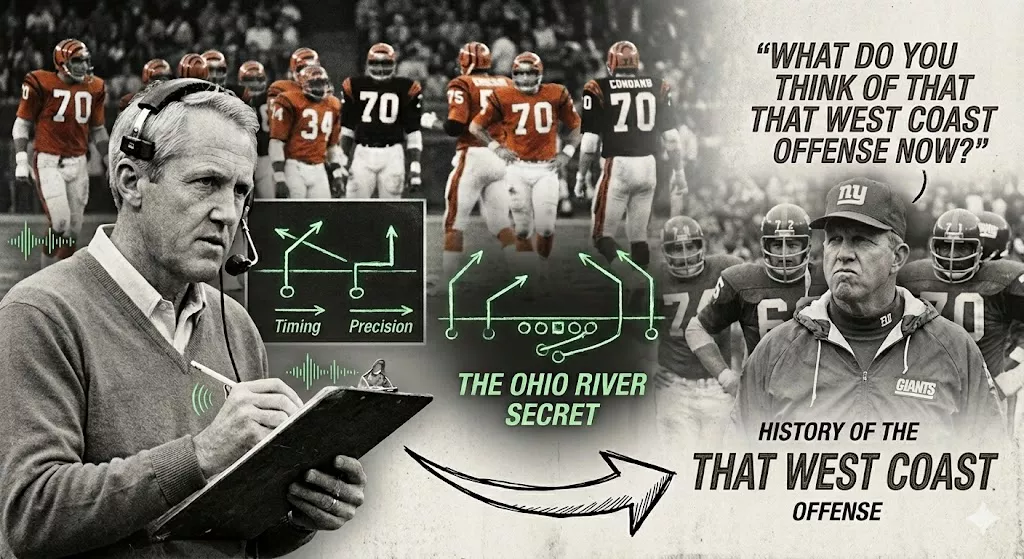
The “Ohio River” Mistake: A History of the West Coast Offense
In the world of the 2026 New York Jets, the term “West Coast Offense” is synonymous with the 2026 offensive playbook installed by Frank…