
Best Seasons in Franchise History
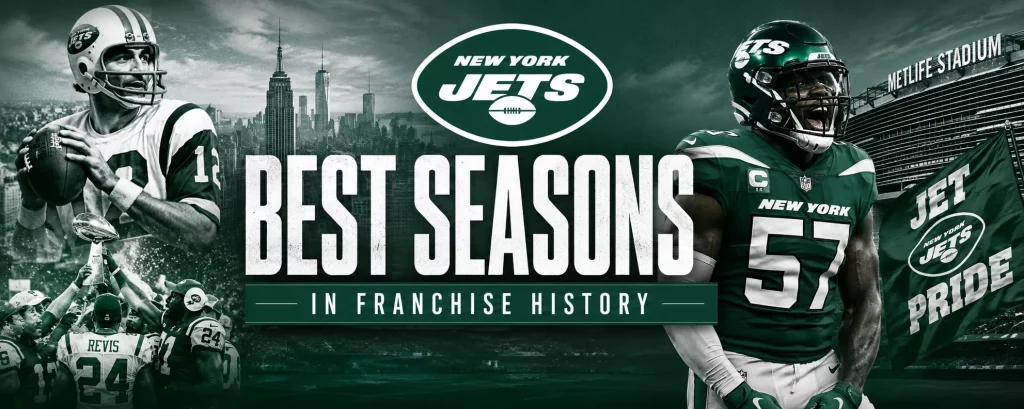
Deep-Dive Tactical Replay & Historical Analysis
1968: The Architectural Standard
The 1968 campaign remains a clinic on roster symmetry. What made this team unstoppable was their situational awareness. In an era where the AFL was criticized for wild, undisciplined track meets, Weeb Ewbank modeled a highly calculated ball-control engine.
Joe Namath didn’t simply throw deep; he manipulated secondary safeties with his eyes better than anyone in pro football. When opponents dropped deep to take away Don Maynard, Namath calmly checked down to George Sauer across the middle. This balance wore opponents down mentally, forcing them out of their standard coverages before delivering the knockout punch. They entered Super Bowl III as huge underdogs against the legendary Johnny Unitas and the Colts. But at the Miami Touchdown Club in Miami, on January 9, 1969, Namath unflinchingly declared, “We’re gonna win the game. I guarantee it.” This bold statement was made at a Miami Touchdown Club dinner in response to hecklers who doubted the underdog Jets against the powerhouse Baltimore Colts.
1998: The Parcells Blueprint
If the 1968 team was built on explosive ingenuity, the 1998 team was forged in pure structural discipline. Bill Parcells completely altered the cultural identity of the organization.
Vinny Testaverde put up a career-high 101.6 passer rating by playing smart, mistake-free football. He relied heavily on Curtis Martin’s legendary vision on interior zone runs, forcing opposing linebackers to cheat up toward the line of scrimmage. This opened up intermediate crossers for Wayne Chrebet on third downs. The team finished with a stunning +14 turnover differential, highlighting the high-execution, low-risk style that came definingly close to a Super Bowl berth.
2009–2010: Rex Ryan’s Hybrid Revolution
The consecutive AFC Championship runs of 2009 and 2010 must be analyzed as a unified tactical window. Rex Ryan built a defensive ecosystem that single-handedly shifted how NFL front offices built passing offenses.
The lynchpin of the entire system was “Revis Island.” Because Darrelle Revis could completely eliminate Hall of Fame wide receivers in pure press-man coverage without any safety help over the top, defensive coordinator Mike Pettine was freed up to create absolute chaos with the other 10 players on the field.
The Jets would routinely put 8 defenders on the line of scrimmage, showing complex overload packages that made it entirely impossible for opposing quarterbacks to read the post-snap coverage rotations. Combined with a punishing offensive line anchored by Nick Mangold and D’Brickashaw Ferguson, these teams won ugly, controlled the clock, and struck fear into the elite offenses of the era.
Frequently Asked Questions
- How many times have the Jets made it to the Super Bowl? The New York Jets have made it to the Super Bowl exactly one time in franchise history. That lone appearance occurred on January 12, 1969, in Super Bowl III, where they famously defeated the Baltimore Colts 16-7.
- What is statistically the best season in New York Jets history? The 1998 season holds the franchise record for most regular-season wins, with a 12-4 record under head coach Bill Parcells. However, the 1968 season remains the undisputed greatest overall campaign due to its Super Bowl III Championship.
- How many times have the Jets made the AFC Championship Game? The Jets have advanced to the AFC Championship Game four times since the AFL-NFL merger: 1982, 1998, 2009, and 2010.
- Who coached the Jets during their back-to-back playoff runs in 2009 and 2010? Rex Ryan coached those iconic “Ground-and-Pound” teams. He became the first head coach in franchise history to lead the team to consecutive AFC Championship appearances in his first two seasons.
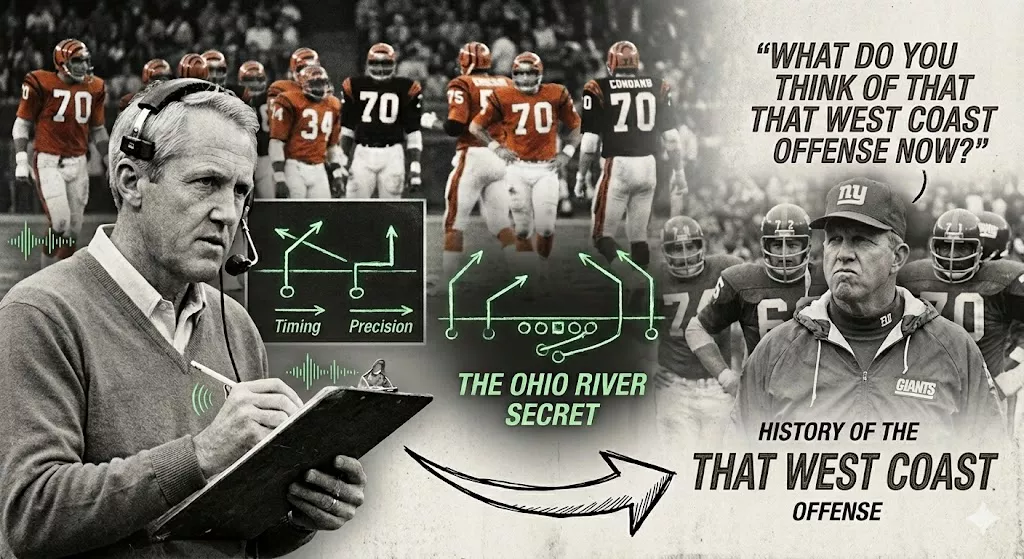
The “Ohio River” Mistake: A History of the West Coast Offense
In the world of the 2026 New York Jets, the term “West Coast Offense” is synonymous with the 2026 offensive playbook installed by Frank…
More Jets History
Franchise history, retrospectives and archive features, newest first.