
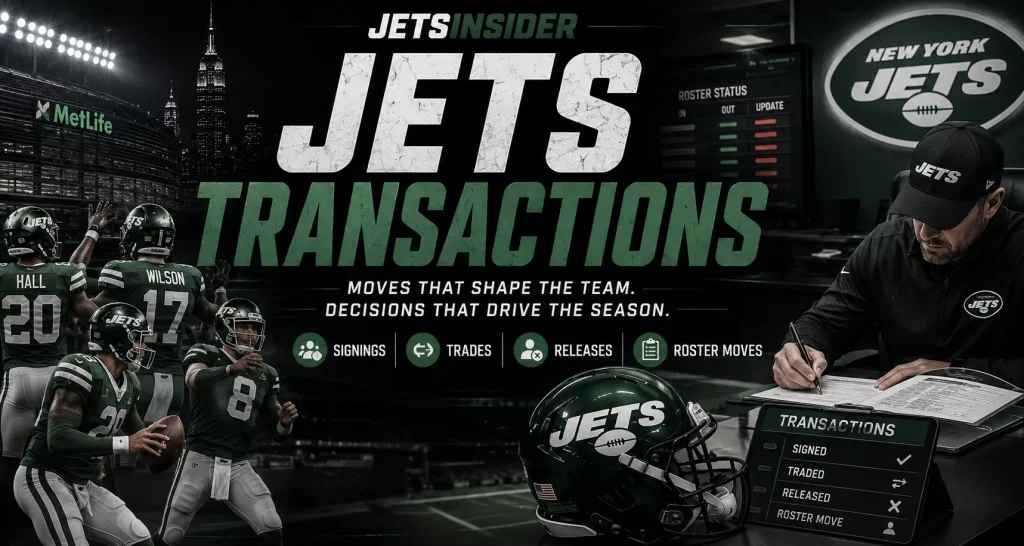
Jets transactions are the official roster moves the New York Jets file with the NFL: trades, signings, cuts, waiver claims, practice-squad moves, injured-reserve placements, and reserve/future deals. Each transaction has its own rules, deadlines, and cap consequences. This page explains the categories, the league calendar that drives them, and how transaction coverage flows into the rest of the Jets news hub and the Jets roster hub.
What an NFL transaction is
An NFL transaction is any roster-status change the league logs to its official transaction wire. The Jets file these through their personnel department; the NFL publishes them daily; the players’ association tracks them for service time. Every move that lands on the depth chart, the injured reserve, or the practice squad starts as a transaction filing, which is why this section is the source-of-record companion to breaking-news coverage.
Common Jets transaction types
| Transaction | What it is | Typical cap impact |
|---|---|---|
| Trade | Player or pick exchanged with another team | Acquiring team takes on remaining base salary and bonus proration |
| Free-agent signing | Unrestricted free agent signs a new contract | New contract counts against the current-year cap, with bonus proration spread over the deal |
| Waiver claim | Team claims a player released within the waiver window | Claiming team assumes the existing contract |
| Release/cut | Team terminates a contract | Remaining proration accelerates (or splits, post-June 1) |
| Injured reserve (IR) | Player moved off the active roster due to injury | Counts against cap; designated-for-return slots are limited |
| Practice squad signing | Eligible player added to the 16-player practice squad | Practice-squad salaries follow a separate scale |
| Reserve/future | Practice-squad-eligible player signed to next season’s offseason roster | Counts toward offseason roster, not in-season cap |
Why it matters
Transactions are the official paper trail for every New York Jets roster decision. A trade rumor becomes real when the wire posts it. A signing becomes real when the contract terms hit the cap sheet. Knowing the categories helps readers translate a single news item into its full impact on the depth chart, the salary cap, and the season ahead. That’s why transaction coverage sits at the center of the news hub, alongside breaking news and roster moves.
What changes next
Every transaction triggers downstream coverage. A new signing reshapes the depth chart, which is tracked on the Jets roster hub. A trade has tactical implications that get unpacked on the Jets analysis hub. An IR placement leads to an injury-update entry. Cuts and additions get aggregated weekly. Each transaction page links to the next layer of context so readers can move from “what happened” to “what changes.”
The NFL transaction calendar (recurring milestones)
- Legal tampering window — Two days before the new league year, agents and teams may negotiate but not sign.
- New league year — Free agency opens; trades that were agreed in principle become official.
- NFL Draft — Draft-day trades reshape boards; undrafted free agents are signed within hours after the final pick.
- OTAs and minicamp — Tryout signings and veteran cuts thin the roster ahead of camp.
- Training camp and cutdown — Roster is trimmed to 53; waivers and practice-squad signings follow.
- Trade deadline — Final day of the regular season’s trade window.
- Post-season — Reserve/future signings and futures-contract filings prepare next year’s offseason roster.
How transaction coverage connects to the rest of the site
A transaction filing is rarely a complete story on its own. The depth-chart consequences are tracked on the Jets roster hub; the cap and tactical implications live on the Jets analysis hub; injury-driven moves flow into the injury-update cluster. Player profiles like Breece Hall bring transactions back to the individual level — every contract extension, IR move, or trade flag attached to that player.
In Brief
- Jets transactions are the official roster moves filed with the NFL: trades, signings, cuts, waivers, IR, practice squad, and reserve/future deals.
- Each transaction type carries its own cap impact and follows its own rules.
- The NFL transaction calendar peaks during the legal tampering window, the new league year, the draft, cutdown weekend, and the trade deadline.
- Transactions are the source-of-record companion to breaking-news coverage on the Jets news hub.
- Every move ripples into the roster hub, the analysis hub, and the injury-update cluster.
Frequently asked questions about Jets transactions
What is an NFL transaction?
An NFL transaction is any roster-status change a team files with the league: trades, signings, cuts, waiver claims, practice-squad moves, injured-reserve placements, and reserve/future deals.
Where are Jets transactions published?
The NFL maintains an official transaction wire; the New York Jets announce moves through their team channels; reporters publish the cap and depth-chart consequences alongside each filing.
What’s the difference between a release and a waiver?
A released veteran with four or more accrued seasons becomes an unrestricted free agent immediately. Younger players go through the waiver wire, where other teams may claim them in inverse-standings order.
How does injured reserve work for the Jets?
A player placed on IR is removed from the 53-man active roster. Teams have a limited number of designated-for-return slots that can bring a player back during the season.
When are Jets transactions most frequent?
Activity peaks during the legal tampering window, the first week of the new league year, the NFL Draft, training-camp cutdowns, the trade deadline, and the immediate post-season period.
Latest Transactions
Signings, releases, trades and practice squad moves, newest first.

Jets Release Troy Reeder and Add Edge Quinton Bell to the Practice Squad
The Jets reshaped their edge on Tuesday, releasing veteran linebacker Troy Reeder and signing edge rusher Quinton Bell to the practice squad. Three more…
Jets Sign Jason Sanders to the Active Roster and Waive Blake Grupe
The Jets signed kicker Jason Sanders to the 53-man roster after three straight practice-squad elevations and waived Blake Grupe and Jordan Clark.
Jets Sign Jamaal Pritchett, Elevate Sanders and Shepard for Detroit
The Jets signed Jamaal Pritchett and elevated Jason Sanders and Sterling Shepard before Detroit. Who they are and what happened.