
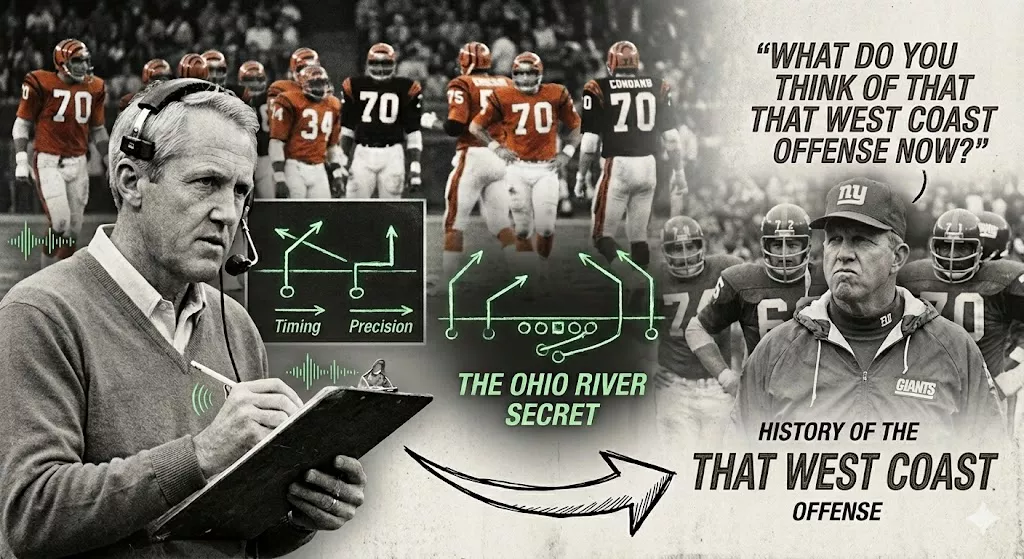
In the world of the 2026 New York Jets, the term “West Coast Offense” is synonymous with the 2026 offensive playbook installed by Frank Reich, yet for over fifty years, the name itself has remained a geographical lie. The most influential tactical philosophy in NFL history was not born on the sun-drenched beaches of California; it was forged in the humidity of southern Ohio, born out of a desperate necessity rather than a stylistic choice.
The Bengals’ Secret: Necessity in Cincinnati
The system’s true origin dates back to 1970 with the Cincinnati Bengals. Assistant coach Bill Walsh faced a personnel crisis: his starting quarterback was sidelined, and backup Virgil Carter lacked the “cannon arm” needed for the era’s deep vertical style of play. Working under the legendary Paul Brown, Walsh realized that if they could not throw over the defense, they would throw under it.
They replaced traditional handoffs with 5-yard “timed” passes, stretching the defense horizontally. This “Ohio River Offense” focused on precision, rhythm, and high completion percentages—tactics that took the Bengals to the playoffs and proved that a “finesse” game could dominate the trenches. It was a revolutionary shift from “run to set up the pass” to “pass to set up the run.”
The Journalistic Error and the Parcells Taunt
If the roots are in Ohio, why do we call it “West Coast”? The label is the result of two historic accidents. First, a 1980s Sports Illustrated article incorrectly applied the label to Walsh’s San Francisco 49ers rather than to Don Coryell’s San Diego Chargers. Walsh, a perfectionist, was reportedly incensed; he viewed his system as a science of timing, while Coryell’s “Air Coryell” was a vertical, explosive style.
The name was permanently cemented in 1985 by a legendary figure from the East. After Bill Parcells’ New York Giants defeated Walsh’s 49ers in a physical playoff battle, Parcells—a proponent of “Smashmouth” football—mockingly asked reporters, “What do you think of that West Coast Offense now?” He meant it as an insult, implying the style was too soft for Atlantic elements. Ironically, the taunt gave the philosophy its permanent, global brand.
The 2026 Connection: Legacy in the Reich Era
Today, the West Coast Offense has evolved into a hybrid beast. In the hands of Frank Reich, it incorporates modern “RPO” (Run-Pass Option) elements and spread concepts that Walsh never imagined. However, the core remains: using the pass to control the clock and manipulate defensive spacing. As the Jets implement this system in 2026, they are participating in a 50-year-old legacy of tactical deception that proves football is a game of angles, not just an outdated test of brute strength.
In Brief
- The West Coast Offense was actually invented in Cincinnati, Ohio, during the early 1970s.
- Bill Walsh designed the system to compensate for quarterback Virgil Carter’s limited arm strength.
- The name was mistakenly applied by the media and later popularized as a taunt by Giants coach Bill Parcells.
- The philosophy prioritizes short, high-percentage timing routes over high-risk vertical shots.
- Modern 2026 iterations, like Frank Reich’s, blend these roots with modern spread and power concepts.
To see how this history is being written in real-time, visit our 2026 offensive playbook breakdown. For more tactical deep-dives, explore our Insiders’ Analysis or join the debate on the JetsInsider Forums.
Frequently Asked Questions
Was Bill Walsh the first person to use the West Coast Offense?
While Walsh perfected it, the system was a collaboration with Paul Brown during their tenure with the Cincinnati Bengals in the early 1970s.
What is the main difference between West Coast and Air Coryell?
West Coast focuses on horizontal timing and short passes, while Air Coryell is a high-risk, high-reward vertical system.
Why did Bill Parcells call it the ‘West Coast’ offense?
He used the term mockingly after a 1985 playoff win to suggest the 49ers’ passing game was too ‘finesse-oriented’ for East Coast football.
Is the West Coast Offense still used in the NFL today?
Most modern NFL offenses are ‘hybrids’ that use West Coast timing and progression concepts as their foundational passing structure.
How does the West Coast system benefit Breece Hall?
By stretching the defense horizontally with the pass, it removes defenders from the box, creating more space for the running game to operate.
What makes the system ‘timing-based’?
The quarterback is coached to throw the ball at a specific step in his drop, often before the wide receiver has even made his final break.