
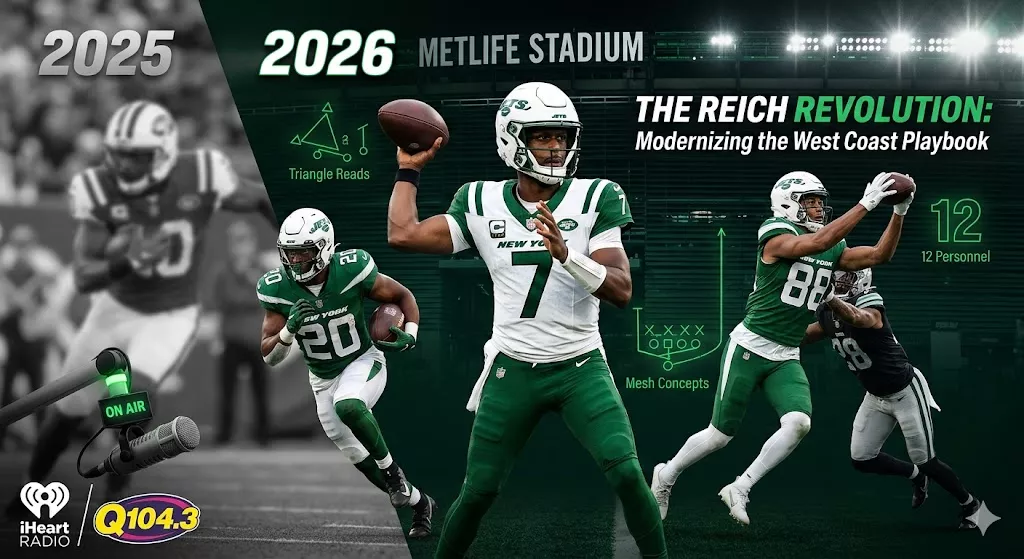
The 2026 New York Jets offensive system under Frank Reich marks a departure from tactical rigidity toward a fluid, “mismatch-based” West Coast philosophy. By marrying traditional horizontal passing concepts with modernized vertical seam-stretching, Reich is transforming a unit once defined by predictability into a multi-layered attack. This system is designed to paralyze defensive coordinators by forcing them to account for elite individual traits within a cohesive, high-tempo structure.
What’s Happening: The Tactical Pivot
Since his arrival in February 2026, Frank Reich has focused on “re-energizing” the playbook by heavily deploying 12 personnel. By placing two versatile tight ends on the field, the Jets effectively dictate the defensive response. If a coordinator stays in a “Base” defense to stop the run, Reich utilizes the vertical speed of his tight ends to exploit linebackers; if the defense moves to “Nickel,” Breece Hall is unleashed against a lighter front.Why It Matters: Designing for Elite Traits
In the previous era, the Jets often forced stars into a pre-existing scheme. Reich’s philosophy is the inverse: the scheme is the vehicle for the stars. For Garrett Wilson, this means a high volume of “triangle reads” and “mesh concepts” that utilize his elite change-of-direction. For Geno Smith, the system provides a structured timing-based environment where his veteran ability to identify “1-high” vs “2-high” safety shells before the snap becomes a primary weapon.What Changes Next: The Red Zone Evolution
The final piece of the Reich revolution is the integration of Kenyon Sadiq as a “chess piece” in the red zone. Historically, the Jets have struggled when the field shrinks. Expect the 2026 system to lean heavily on Sadiq’s 4.4-speed to stretch the back of the end zone, creating space underneath for Breece Hall. As the offensive line masters Reich’s zone-blocking assignments, the Jets project to be one of the most balanced scoring threats in the AFC East.In Brief
- Frank Reich has installed a modernized West Coast offense focused on “mismatch theory.”
- The system uses 12 personnel as its primary tool for dictating defensive substitutions.
- Geno Smith serves as a veteran field general capable of executing complex timing-based reads.
- Garrett Wilson and Breece Hall have roles designed specifically to accentuate their unique traits.
- Kenyon Sadiq is the designated “vertical threat” tight end meant to solve red-zone droughts.