
What Is an NFL Depth Chart? How to Read One
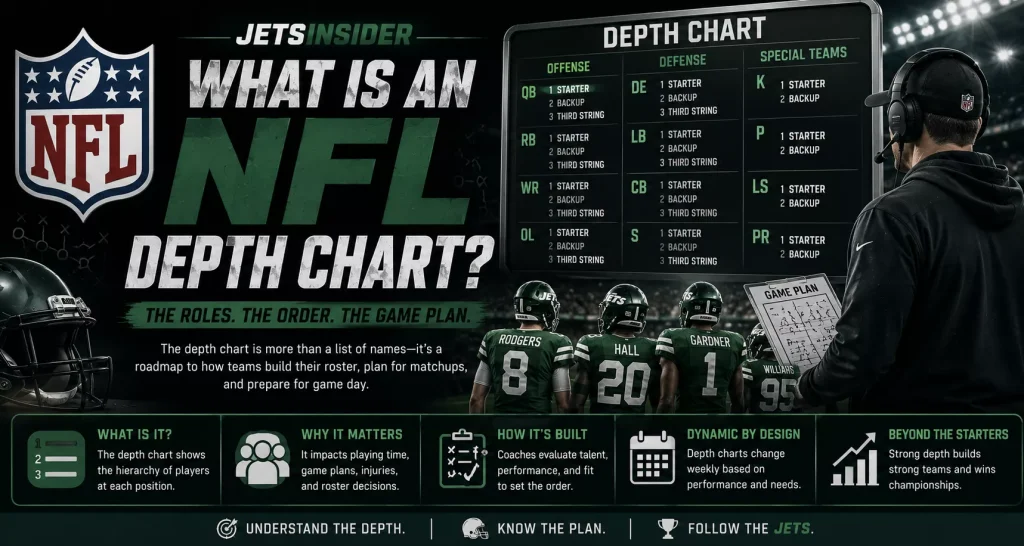
An NFL depth chart is a ranked list of a team’s players at every position, with the projected starter at the top and backups below in order. It maps who plays first, second, and third at each spot across offense, defense, and special teams — a quick snapshot of how a roster is organized and where the competition sits.
For fans following the New York Jets, the depth chart is the fastest way to read the roster: who starts, who is a snap away, and which position battles are still open. This guide explains how a depth chart is built, how to read the order and abbreviations, and what makes it change. For the team’s live version, see our Jets Roster Hub.
What does a depth chart mean in football?
A depth chart shows the pecking order at each position. The player listed first is the projected starter; those below him are the backups, ranked by how likely they are to play. Teams keep a depth chart for all three phases — offense, defense, and special teams — so the full document lists dozens of players from quarterback down to the fourth-string roles and specialists.
How do you read an NFL depth chart?
Read it top to bottom by position: the first row is the starter, the second is the primary backup, and so on. Positions are grouped by unit and labeled with standard abbreviations. Knowing the shorthand makes any chart easy to scan.
| Term | What it means |
|---|---|
| 1st string / starter | The player expected to take the first snaps at that position |
| 2nd & 3rd string | Backups in order of preference behind the starter |
| “OR” | Two players listed as even — an open competition with no clear starter yet |
| QB / RB / WR / TE | Offensive skill positions: quarterback, running back, wide receiver, tight end |
| LT / LG / C / RG / RT | Offensive line, left to right: tackles, guards, and center |
| DE / DT / LB / CB / S | Defense: line, linebackers, and the secondary (cornerbacks and safeties) |
| K / P / LS | Special teams: kicker, punter, long snapper |
Reading tip: when you see two names joined by “OR,” the job is genuinely up for grabs — those are the rows to watch through training camp and the preseason.
Who makes the depth chart, and is it official?
Coaching staffs set the depth chart, and teams release an unofficial version during training camp and the preseason. It is best understood as a planning tool rather than a binding document — coaches often caution that early charts are alphabetical or intentionally vague, partly as gamesmanship. The order that actually matters is the one revealed by who takes first-team reps in practice and who starts once real games begin.
What makes a depth chart change?
Depth charts are living documents that move constantly. The most common drivers are injuries, roster transactions, and performance. When a starter is placed on injured reserve, everyone behind him shifts up, and a team may sign a replacement or promote a player from the practice squad. Trades, waiver claims, and standout camp performances also reshuffle the order well before Week 1.
How does the depth chart connect to the 53-man roster?
The depth chart is the organized view of the active roster. NFL teams carry 53 players on the active roster plus a practice squad, and the depth chart arranges those active players by position and rank. Because roster limits are fixed, adding depth at one position usually means less at another — which is why the chart is such a useful lens on how a team has chosen to build itself.
In Brief
- A depth chart ranks players at each position: starter first, backups below.
- It covers all three phases — offense, defense, and special teams.
- “OR” between two names signals an open competition with no set starter.
- Charts released in camp are unofficial planning tools, not final lineups.
- Injuries, trades, waivers, and camp performance change the order all season.
Ready to see it in practice? Explore the Jets’ current depth chart and starting lineup, then dig into the full Roster Hub for player-by-player pages.
Frequently Asked Questions
What is a depth chart in the NFL?
An NFL depth chart is a position-by-position ranking of a team’s players, listing the projected starter first and backups in order below. It covers offense, defense, and special teams and gives a quick picture of who plays where and which jobs are still open.
What does “OR” mean on a depth chart?
“OR” between two players means the coaching staff considers them even at that position. It signals an open competition with no clear starter yet — typically a battle that will be settled through training camp reps and preseason games.
Are NFL depth charts official?
Teams release unofficial depth charts during camp and the preseason, and coaches often downplay their accuracy. They are planning tools rather than binding lineups. The most reliable read on the real order comes from who takes first-team practice reps and who actually starts in games.
How often does a depth chart change?
Frequently. Injuries, trades, waiver moves, practice-squad promotions, and strong or weak performances can all reshuffle the order — sometimes week to week. That is why fans check an updated depth chart throughout training camp and the regular season.
How many players are on an NFL depth chart?
A depth chart organizes the active roster, which holds 53 players, plus specialists and rotational depth. Because every position lists a starter and one or more backups across offense, defense, and special teams, a full chart names dozens of players.
Latest Roster Updates
Depth chart moves, promotions and roster decisions, newest first.
New York Jets 2026 Offseason Roster Tracker: Every Key Move Before Training Camp
New York Jets 2026 Offseason Roster Tracker: Every Key Move Before Training Camp Published: June 20, 2026 | By: Bruce Dugan | Category: Roster…
Inside the Jets’ 2025-26 Roster Teardown: Grading the Quinnen, Sauce & Johnson Trades
When Aaron Glenn took over as head coach and promptly stumbled to a 3-14 record in 2025, the message from the New York Jets…
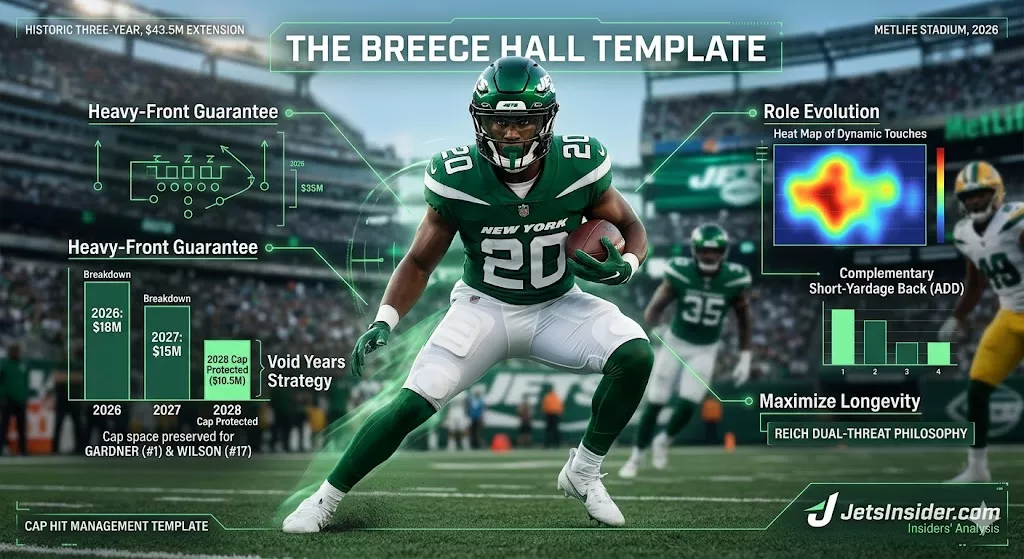
Contract Breakdown: Breece Hall’s Extension & the RB Market
Breece Hall contract breakdown for the New York Jets: extension terms, guarantees, and what the RB market means for 2026.